JOLYNE ★ CUJOH (![[personal profile]](https://www.dreamwidth.org/img/silk/identity/user.png) superstringtheory) wrote2016-07-03 02:36 am
superstringtheory) wrote2016-07-03 02:36 am
superstringtheory) wrote2016-07-03 02:36 am


application ( forest covered )
( PLAYER INFORMATION )
Name: Anne
Contact:![[plurk.com profile]](https://plurk.com/favicon.ico) passiones
passiones
Are you over 17?: Yes!
Characters in Forest Covered: N/A
( CHARACTER INFORMATION )
Name/Work Name: Jolyne Cujoh; "Umiko"
Canon: Jojo's Bizarre Adventure: Stone Ocean
Canon Point: CANON | Chapter 155, just after her death and universe reset; CRAU | during the Land of the Dead event, May 2016
AU/CRAU: Y, CRAU
Age: 19
History: @ JOJOWIKI.
Personality:
Previous Game Info:
Inventory:
Abilities:
( SAMPLE )
Characterization Sample: & rohan; i'll think about it.
Name: Anne
Contact:
Are you over 17?: Yes!
Characters in Forest Covered: N/A
( CHARACTER INFORMATION )
Name/Work Name: Jolyne Cujoh; "Umiko"
Canon: Jojo's Bizarre Adventure: Stone Ocean
Canon Point: CANON | Chapter 155, just after her death and universe reset; CRAU | during the Land of the Dead event, May 2016
AU/CRAU: Y, CRAU
Age: 19
History: @ JOJOWIKI.
Personality:
Jolyne Cujoh is metal as fuck.Debt: Jolyne will deal with the Witch to: 1) save her own life; 2) save the lives of her immediate loved ones; & 3) keep Pucci from resetting the universe and effectively killing everyone on Earth by doing so.
Which is not a good personality section, but functions as a decent thesis statement. A better one might be: Jolyne Cujoh ends up metal as fuck, in the finest tradition of protagonists in this canon. However, as is similarly typical, she starts out a hot mess. Her very first appearance in Stone Ocean is her showing a somewhat depressing amount of surprise at being caught masturbating by a guard in her incredibly-public prison cell. This is pretty indicative of her initial immaturity overall. She's shown to be bad at making independent decisions, hugely naive (especially with men), and volatile when upset, with a tendency to act out in a criminal capacity despite her basically moral tendencies.
This immaturity never completely goes away. Big damn hero or not, the fact remains that Jolyne is nineteen and sometimes nineteen-year-old levels of ridiculous. Like pretty much every Joestar or descendant thereof (especially her great-grandfather Joseph and her father Jotaro), she elevates bullshittery to a fine art. She has a tendency to horse around with her friends, especially Hermes and FF, and postures a good bit when she's comfortable in her surroundings, using masculine or "macho" language rather than feminine. She tends to yell a lot and is very expressive and exuberant. She also displays a tendency to use misogynistic and homophobic language without apparent thought to the consequences. What's unclear about these and other almost frat boy-esque qualities is whether they're simple acting out, a result of her time in a motorcycle gang as a young teenager, or a survival mechanism for life in a co-ed and essentially lawless prison run by an insane priest who's trying to end the world. Safe bet is on all of the above.
Jolyne's more subtle traits become clear much more slowly throughout the course of canon. The first to pop up is another Joestar favorite. Remember the fine art of bullshittery? Well, extend that a little further and you get Jolyne's astonishing talent for improvisation. She is almost defiantly not book smart, but she's got a Macgyver-esque ability to pull any kind of ridiculous bullshit together in the spur of the moment in order to solve a problem. Combined with both the swagger of Joseph and the stoicism of Jotaro, she's a ridiculously competent problem-solver and a serious opponent in a fight, despite her relatively weak Stand. She even sets herself on fire one time as a battle strategy. Like literally every other Jojo. Ever.
Where she differs a little from other members of the bloodline is in how far she's willing to carry her trust. A tendency to make allies and friends quickly, especially in the heat of battle, is a trademark of series protagonists. However, Jolyne takes her faith in near-strangers almost too far, sometimes to the point of open manipulation. An excellent example of this is when she and Hermes first encounter FF and have to fight her in order to retrieve a plot-important artifact. It's down to the wire, Jolyne is gravely injured, and she has to put the burden of dangerous action on Hermes's shoulders; however, Hermes isn't willing to put Jolyne's life on the line, worried about Jolyne's safety and her own possibility of failure. That doesn't stop Jolyne, though - she forces Hermes's hand by starting the play, while yelling over her shoulder that it's the "only way". It all turns out more or less fine in the end - nobody dies, Hermes learns to trust Jolyne's judgment implicitly, FF becomes an ally - but that doesn't change the fact that it was a damn manipulative move, whether or not it was interpreted as such.
In a similar vein, Jolyne can be remarkably ruthless for a girl who's so ~zany on the surface. There are countless examples of this, but a few in particular stand out. The first one pops up in the first few chapters. One of Jolyne's first priorities after discovering her Stand powers is to get rid of the corrupt lawyer who set up her frame job, conviction, and imprisonment to fifteen years. Keep in mind that "get rid of" does not, in this case, mean disable, humiliate, or in any way leave alive. No, Jolyne straight up kills him in cold blood. While this isn't a wholly terrible act because the guy is very clearly a massive criminal dick, it's also not a completely above-board move. Similarly, when Jolyne and her crew escape from prison, they make a beeline for Romeo Jisso, Jolyne's ex-boyfriend and another party culpable for her false imprisonment. Jolyne's concern seems to be that he won't give anything away to the cops when they find out that she's escaped - but even after she hears him lie to the police and tell them that she's crossing the border into Mexico, she rips out his tongue anyway. You know. Just in case.
This tendency towards ruthlessness doesn't only manifest as random acts of violent revenge, though. In fact, it tends to be a positive survival trait the vast majority of the time. Just like her father, she's almost supernaturally cool under pressure. Everybody else freaks out; it's Jolyne's role to be the chill in the party. It's also notable that this tendency doesn't emerge until after she's seen her father fight; despite her largely negative feelings towards him, she seems to take his attitude in crisis as an example and is very eager to imitate and perfect it. Further, as briefly mentioned above (and as is also depressingly typical of this bloodline, because self-sacrifice appears to be genetic), Jolyne is willing to take huge risks, especially with her own safety. A great example of this is when she's fighting Pucci and he turns her fingers inside-out. It is super gross, and Emporio is screaming bloody murder over this, like a normal person, but Jolyne just looks at him and calmly reassures: "Don't panic, Emporio. If I start turning inside-out when he hits me, then I'll just let him hit me again so I can flip myself back." No big deal?
Jolyne's compassion comes into the spotlight a little more slowly. Because of the frantic nature of her time in Green Dolphin Street Prison, during which she's almost constantly under enemy attack, it takes her a while to really come into her own as a caring leader. She does get there, though, and when she does, she's absolutely spectacular. She seems to instinctively understand how to approach each person, tailoring interactions to fit their needs. Appropriately enough, the first really obvious moment of compassion is at the tail end of the conflict with FF. Hermes urges Jolyne to let FF die, but instead Jolyne saves her, because she believes this former enemy deserves a second chance. From that moment on, FF is loyal to Jolyne and Hermes above all and eventually gives her life to protect them. Another example can be found in Jolyne's relationship to her friend named (I shit you not) Weather Report. Weather is somehow simultaneously annoyingly mysterious and obnoxiously rude, and that's before his (legitimately) tragic backstory is revealed and he gets his memory back, after which he turns into a bitter, murder-suicidal asshole. However, Jolyne never judges him. Not once. She loves him like family, tries desperately to save him, refuses to believe he's dead, and grieves him as well as she possibly can in the limited time available to her. She's able to separate his actions from his character, which is honestly a remarkable amount of development when you consider where she started at the beginning of the series.
Maybe most significant to Jolyne's character, though, is the way she treats Emporio. A little background is necessary here: Emporio Alniño is trapped in Green Dolphin Street Prison just like Jolyne is - except he's an eleven-year-old boy whose mother bore him in prison and then was probably killed by Pucci. He's timid and slow to action, literally living in the walls of GDSP; his entire life until he meets Jolyne has been hiding like a fugitive. Now you might not expect Jolyne to be a terrifically nurturing person, given Bad Dad Jotaro Kujo (trust me: I'll get there), but she did have one quite functional parent: her mother, who was always there, always forgiving, maybe sometimes a little too lenient but overall did the best she could. It's her mother that Jolyne takes after in this case, because although it does take her a while, she does eventually take on a very maternal and protective role towards Emporio. In contrast to her infrequent non-horseplay-related physical touch with the adults in her life, she's remarkably gentle with Emporio, even hugging him a time or two. In the end, when it comes down to the wire, she not only dies to protect him, but gives him the confidence and the power to ultimately destroy Pucci. If we're continuing the extant motif, Emporio came to her a caterpillar and emerged from her arms a butterfly, ready and willing to flap his wings and start a big damn storm.
And so here we are with Jolyne Cujoh, the little girl who turned into a big damn hero in the space of a rough few months on Araki's wild ride. How she got there, though, her journey, that's the skeleton of Jolyne; everything else is just muscle and skin. She didn't get where she is because of Pucci - fuck that guy - or because of her friends - although they're great. No, her motivation has always been centered around one person: her father, Jotaro Kujo.
The fact is that Jolyne started out an incredibly, dysfunctionally insecure person, and the responsibility for that rests squarely on her father's shoulders. He was never a consistent figure in her life or her mother's; he traveled often for school and then work, sometimes being away for months at a time. He literally wouldn't talk to her desperate mother when Jolyne stole a car and ended up in jail at fourteen. After her parents divorced, Jolyne didn't see Jotaro for years. The end result of all of this was a combo platter of resentment towards Jotaro and an extreme craving for his affection, which led her to do some magnificently stupid shit - acting out, committing grand theft auto, joining a motorcycle gang, dating Romeo . . . you get the picture.
Her resentment continues through Jotaro's attempt to break her out of prison but comes to an abrupt, screeching halt when Jotaro sacrifices his soul and Stand to save her. That action doesn't fit at all with her perception of him as an uncaring father, and it throws her so much that she's forced to reevaluate her outlook very quickly. The decision she ultimately makes is to follow the purpose that's been handed to her by, well, probably destiny: to save her father's soul, punch a priest, and save the world. This is the catalyst for her growth into a clever and compassionate leader, and so, paradoxically, without Jotaro she would neither have been insecure nor pushed to greatness. Probably she'd have rather had a normal childhood with a dad who went to school plays and shit, but you know, this is okay too.
It takes a long, long time and a lot of work, and honestly her insecurity will never completely go away, but she does get to a place by the end of Stone Ocean where she's capable of trusting Jotaro again. After his soul is restored and in a moment of extreme crisis, she calls out to him with complete certainty that he'll come for her. If they'd both lived, if they'd been victorious, it would have been possible, albeit difficult, for them to start building a healthy relationship. Unfortunately . . . well, things happen. You know how it is.
A final note: as is probably obvious by now, this canon is in very large part a story about legacy, about blood, about the power of family and fate. Jolyne's story is a little more narrowly focused than that, though. The Joestar legacy is important in that it drives the story, every action in Stone Ocean built on actions enacted by Jolyne's predecessors in previous arcs, and in how the trauma of the legacy informs Jotaro's actions. However, Jolyne is, at least to some extent, more a Cujoh than a Joestar. She's driven to protect her father; she's driven to protect her friends, her found prison family. Her conception of belonging and togetherness is not traditional, but cobbled together from the people who are willing and able to put their trust in her and earn her trust back. Family is flexible. What she wants more than anything is to be loved, to belong, and to protect her people.
Also to kick some ass. Because like I said: she's metal as fuck.


Previous Game Info:
After she died, Jolyne was offered a deal by the Admiral, the head NPC on the Barge at The Last Voyages (lastvoyages). The Admiral could grant her any wish, on the condition that she came to the ship and acted in the capacity of a warden — something like a combination of guard and mentor — to one of the ship's prisoners, or inmates. The purpose of every warden is to redeem their individual inmates. Jolyne agreed to this deal: her term as a warden in exchange for her universe being saved from Pucci. She also intended to stay on board the Barge for at least a second inmate deal, in order to save her family and friends from death.
Jolyne quickly made connections with several other people on the Barge, although admittedly none of those connections were particularly deep at first. She was still very much in shock from her own death, not to mention the deaths of all the people she cared about and the end of the actual world. As a result, she wasn't interested in making close relationships, for fear that she would somehow lose those people, too — not to mention that she simply didn't have the energy to do so. On the other hand, she didn't really take time to rest and recover, emotionally or physically, from her own death; she simply pushed forward and ignored her own grief and trauma in the interests of getting the job done.
She was quickly paired with the inmate Pitch Black, the personification of fear. While Pitch was regularly perplexed by Jolyne's cheerful demeanor towards him, she was never scared of him — indeed, she was more curious about his thoughts and opinions about fear and how it affects people than she was worried for her own safety and security. She also agreed with his estimation that it wasn't right for him not to have his powers, since despite the danger associated with them, they were a part of him. Because of this, after she was paired with him, she asked the Admiral to have his powers restored. She held Pitch in very high regard and liked doing things with him, despite the fact that he constantly told her she was really weird for not being afraid of him.
Another important person in her life, and the first real friend she made after her death, was Kishibe Rohan. They didn't trust each other at first, given the fact that he was the first person she saw on board with a Stand and vice versa, but because Rohan had known her father and he was curious about her information as well as why she was on board in the first place, they started talking and soon became close. It took a while for them to learn how to communicate with each other effectively, because their personalities and communication styles were very different, but after a while they began to trust each other implicitly. Rohan was the first person Jolyne told about her own death; she went to him for advice, because she knew he would be unflinchingly honest. In turn, Rohan encouraged Jolyne to prioritize herself and see her life as worth living again and allowed her into his space, as well as helping her learn about aspects of her own life that she had not previously been aware of — details of Japanese culture and her father's life especially.
Additional important CR for Jolyne was Rey, Jean Gray, and Scott Summers. Jolyne saw Rey both as someone to be admired and someone she wanted to help; her previous isolation made her very socially awkward and abrupt, and Jolyne liked that bluntness as well as her resolve and principles. She showed Rey how to do some normal young adult stuff, whether she liked it or not. Jean Gray was someone Jolyne felt tentatively comfortable with. Jean made Jolyne feel safe, and as such she told Jean a few things about her life, her powers, and her father. After Rohan, Jean knew the most details about Jolyne's life and death. Finally, Scott Summers was a semi-paternal figure to Jolyne. She prided herself on her ability to tease him and make him smile or even laugh, and he expressed concern (in his understated way) for her safety and security. It frustrated her that he would never let her help him in return, but their relationship was overall positive, and she felt very strongly that he was an admirable and principled person and a good role model.
Overall, the Barge was a mixed experience for Jolyne. There were very few events that rocked her significantly, in large part because she was so traumatized and numb from what she experienced in canon that she hadn't recovered enough to feel very affected by current events. In other words, she was saturated, unable to take much else in. The event that frustrated and upset her the most was one in which she was transformed into her younger self, from right after she met her father in prison and his disc was stolen by Pucci. However, that was more upsetting to her because her younger self revealed too much to the Barge at large than because she felt moved by it.
What affected her more than events were the people around her, as well as the simple passage of time. There were a large number of people who were friendly to her and a few who were even openly concerned for her safety and happiness, who noticed that she wasn't actually happy, just acting like it. While she was able to brush this off for a while, she couldn't forever, and after Rohan told her explicitly that she needed to prioritize herself, she started thinking about it: why she didn't care about much of anything, including herself, and what would make that feeling change. She never came to a concrete conclusion, but she did end up changing her deal with the Admiral to save her own life first, with everything else coming after.
Jolyne's time on the Barge came to an end at the beginning of the Land of the Dead event. The Barge itself was drawn inexorably towards and ultimately crashed into the Land of the Dead, and all passengers were deposited there and separated from a manifestation of their souls. In Jolyne's case, that means she was temporarily separated from her Stand, Stone Free. Towards the beginning of the event, Jolyne disappeared and never returned to the Barge.
Inventory:
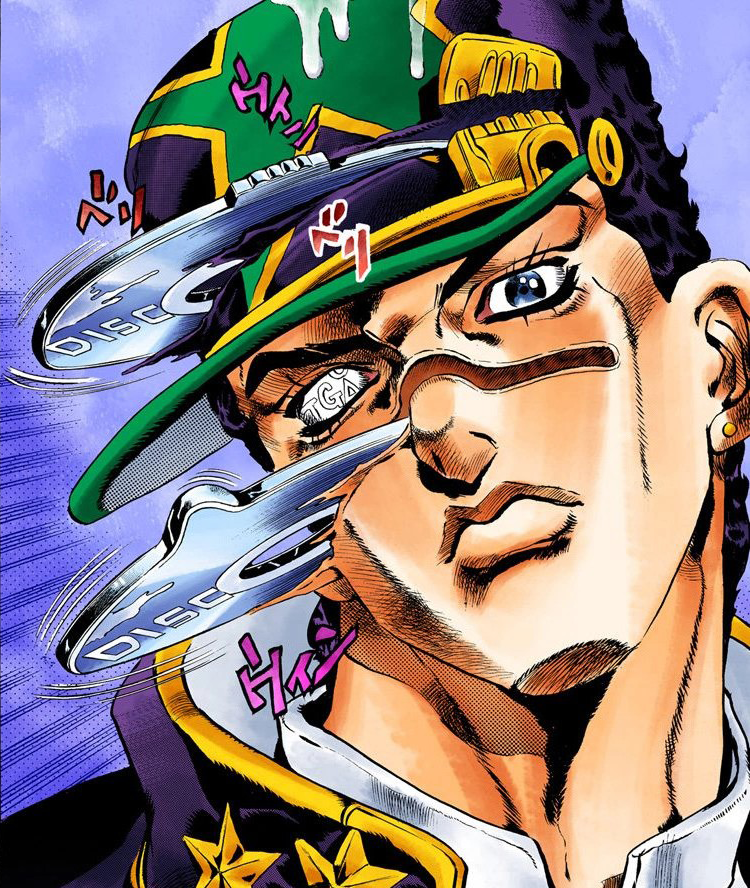
☆ ONE ( 1 ) STAR PLATINUM DISC, on a chain
★ ONE ( 1 ) BLACK & GREEN DRESS
☆ ONE ( 1 ) GLASS PAPERWEIGHT, with flowers pressed inside
★ ONE ( 1 ) NOTEBOOK, handwritten & illustrated
☆ TWENTY-EIGHT ( 28 ) COLORS OF NAIL POLISH, with matching lipstick & hair dye


Abilities:
Jolyne is a Stand user! What the hell is a Stand user? That's a great question, because a lot of times it seems like the series itself has no idea. Described variously as a manifestation of one's psyche or as one's fighting spirit, a Stand is basically a big (sentient-ish, sometimes) ghost thing that has special powers and punches stuff. You can be born with a Stand, develop it later in life, or, if your dad's a fucking asshole, get poked with a magic arrow and develop one mysteriously with no explanation even though he could totally tell you what's going on, but no, that would be too easy. Thanks, Jotaro.Strengths and Weaknesses:
Anyway. Jolyne's Stand is called Stone Free. She named it this, because she is a huge nerd. Basically what Stone Free does, besides wear sunglasses indoors, is allow Jolyne to turn into string - which sounds like a garbage power until you remember that Joestars are genetically weirdly creative people, and Jolyne is completely capable of using her stupid string power to fuck people up six ways from Sunday. She can unravel 70% of her body and reach up to 24 meters away from her body with her weird body horror string, which means she can set traps, ball herself up really small and climb into people's mouths, hang from the ceiling like Spider-Man, play cat's cradle with herself, et cetera.
Other weird shit Stone Free can do: stitch up wounds, enable Jolyne to hear conversations at a long distance, and turn her into a möbius strip (this is actually tactically advantageous at one point, I shit you not). Finally, of course, her punchghost is good at punching. According to the wiki linked above, "When Stone Free's string is completely wound or compacted . . . the destructive force of its punch is roughly equivalent to that exerted by a small, extremely fast meteor." So, in layman's terms, it punches really fucking hard.
✓ CREATIVITY. Jolyne is a highly creative person, much like most of the titular Jojos in Jojo's Bizarre Adventure. When she finds herself in a difficult situation, she almost never freezes up; instead, she finds a way to use her environment to her advantage. She also uses her Stand to great effect, despite the fact that from a less creative, more straightforward perspective it might not be that useful.
✓ LOYALTY. Jolyne makes quick bonds with people, and once those bonds are made, they are very, very difficult to break. Her relationships with all of her allies (minus Annasui) are good examples of this tendency, but perhaps the most significant example is of Weather Report. When she meets him, he's very quiet and unsettling, but she still considers him an ally and quickly a friend; when his memory returns and he becomes violent, nihilistic, and vengeful, she still openly cares about him and expresses open anger and grief at his death.
✓ SENSE OF HUMOR. Although she's absolutely capable of seriousness, Jolyne is also great at lightening tense moments with humor. Sometimes it comes in the form of oversharing, but just as often she just wisecracks. She does her best to make all of her friends laugh even at very difficult times in their journey, which helps to foster camaraderie and trust between them and make things seem less tense overall.
✓ PROTECTIVE INSTINCT. Jolyne is very protective of her friends and family, but especially of children. This is most in evidence with Emporio, a child trapped in Green Dolphin Prison who has grown up without parents. She appears to see a lot of herself in him and, as a result, wants to make sure he has the support of an adult figure in his life. She is constantly checking in on him, both verbally and physically, and her last living act in Stone Ocean is diverting Pucci away from him so that Emporio can live.
✓ INTUITION. Jolyne is a highly intuitive person. She makes a lot of her decisions based on her ability to read and judge people, and her intuition is usually correct. The best example of this is her judgment of Foo Fighters, who is initially an enemy working for Pucci. Hermes wants to kill her, but Jolyne believes she can be trusted, and so ultimately decides to offer her the hand of friendship.
✕ IMPULSIVITY. The flip side of Jolyne's strong intuition is a tendency for her to make impulsive decisions rather than reasoned ones. Often they work out in her favor, but she is more likely than a more ration-based person to run into a dangerous situation without waiting for backup, for example.
✕ INSECURITY. For a lot of reasons, but especially because she spent so much of her childhood seeking her absent father's approval and never receiving it, Jolyne struggles with strong feelings of insecurity. This has manifested in a few ways, but the most significant in her daily life is the way she gravitates towards dirtbag guys and has trouble saying no when they ask things of her. The obvious example of this is Romeo, the guy she's with when Stone Ocean opens, who (with the help of a lawyer he hired) successfully tricks her into taking the fall for a hit-and-run accident he was responsible for.
✕ TEMPER. Like pretty much every single one of her ancestors, when Jolyne's temper is roused, there's pretty much no stopping it. This can be a tactical advantage in very specific circumstances, but most of the time it just makes her unwilling to stop and think before throwing herself into a challenge headfirst. It also makes her less likely to think before she acts when her friends or family are threatened.
✕ LACK OF SELF-PRESERVATION. In some ways, by the end of Stone Ocean Jolyne is very nihilistic. She's gotten increasingly desperate as the fight against Pucci has continued; the more she's learned of her family's legacy, what her father did to stop Dio and what all of the Joestars who came before him did and how little it mattered, the more afraid she's become that nothing she does will matter. This is why, the further into Stone Ocean we get, the less interest Jolyne shows in saving her own skin. In the end, she chooses to sacrifice herself on the slim chance that Emporio can get away, save them all, and survive. With her father and all of her other friends dead, she sees no purpose in fighting for her life, and so she does her best to at the very least take Pucci with her.
✕ FUTILITY. In the wake of her own death, Jolyne saw no purpose in preserving her own life or indeed in saving herself from death, although that was a possible deal to make on the Barge. Instead, she focused on the things she thought mattered more: the fate of the world itself and the lives of her family and friends. Even when persuaded to put her own life first, she felt she was just going through the motions rather than being really committed to the idea of starting a new life. The combination of her self-esteem issues and the depression that hit after her death have led her to feel a great deal of futility and unwillingness to connect with people on more than a surface level.
( SAMPLE )
Characterization Sample: & rohan; i'll think about it.